What Should an AI Workflow Decide for Your Growth Team?
Use AI to prepare evidence, then decide who can act on it. A practical way to test a growth workflow before giving it permission to make changes.
Imagine your Monday report flags a drop in organic clicks on several product pages. It arrives on time, identifies an owner, and proposes a fix. The report took minutes to produce. The recommendation would affect every page that uses the same template. The value of the workflow now depends on whether someone can tell a real indexing problem from a reporting delay, and whether that person has the authority to decide what changes.
In a recording about a brand engagement, Yiwei describes setting up a routine that posted feedback on project reports in Feishu and tagged the people responsible. That is his account of the implementation. The recording gives no independent measure of how accurate the feedback was or how much time the workflow saved. In a separate recording about how his agency evaluates SEO roles, he distinguishes specialists who handle technical or content work, leads who can coordinate several parts of SEO, and people who can weigh decisions against costs, profit, and cash flow. These two observations belong in the same design discussion. A workflow can move an issue to the person responsible, and the role that person plays determines what should happen next.
Fast answers and correct decisions need separate checks
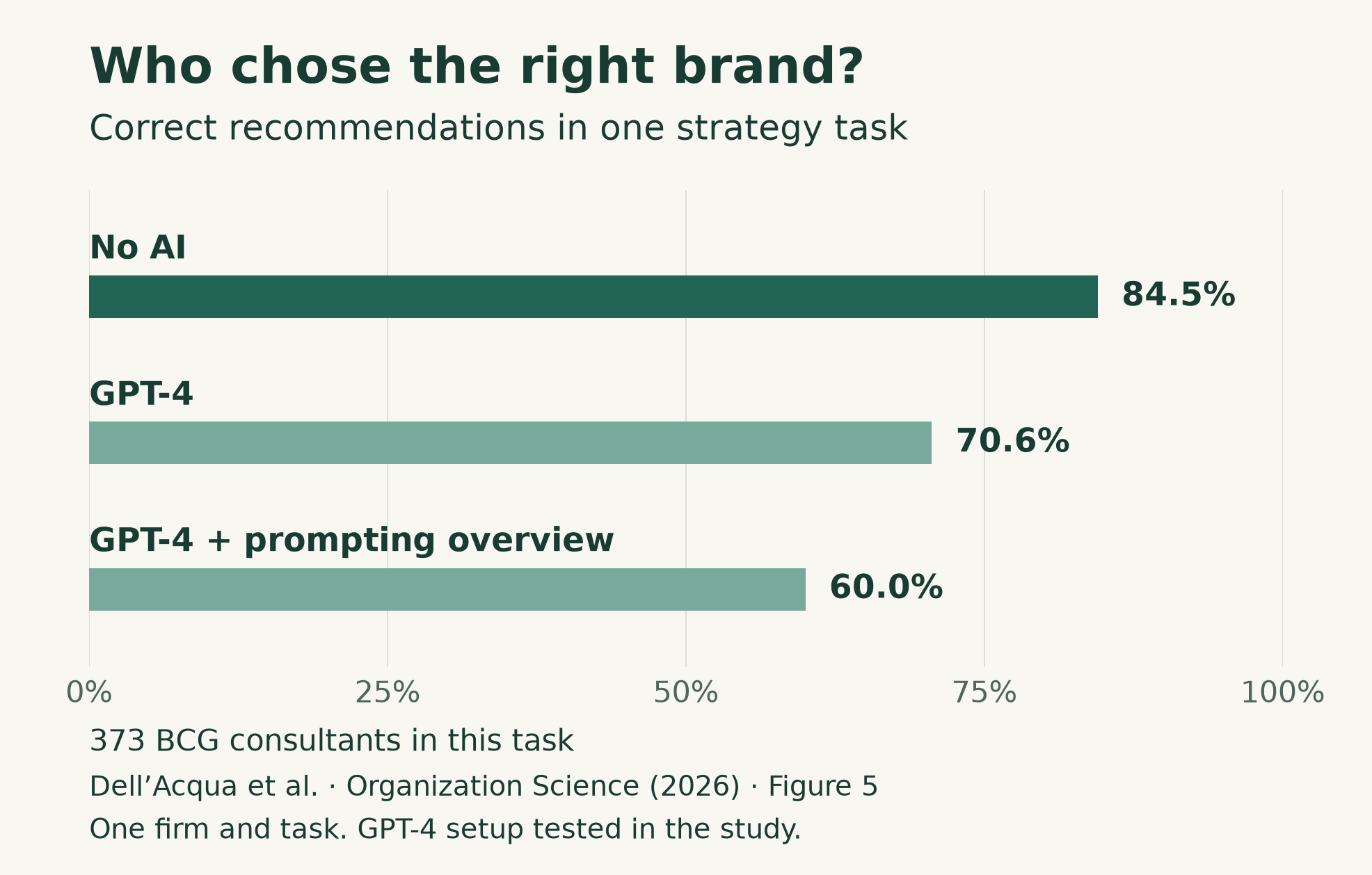
Dell’Acqua and colleagues ran a randomized experiment with 758 Boston Consulting Group consultants. On a set of 18 subtasks in a product launch strategy exercise, GPT-4 assistance improved completion, speed, and assessed quality. A separate exercise asked consultants to choose which brand had the most growth potential by using interviews and financial data. In that exercise, 84.5% of the control group chose correctly, compared with 70.6% of the GPT-4 group and 60.0% of the group that also received a short prompting overview. The authors also found that AI-assisted recommendations in the brand exercise could read more coherently even when the choice was wrong. The difference between the two GPT-4 groups gives little basis for a general claim about training. The experiment used one strategic case, one firm, and a specific model setup. [1]
A different deployment gives a useful example of assistance inside a defined role. In a 2025 study of 5,172 customer support agents at one company, Brynjolfsson, Li, and Raymond estimated that access to a conversational assistant raised issues resolved per hour by 15% on average. Effects varied across workers, and agents could edit or disregard suggestions. That study measured work in customer support. It gives a reason to test whether assistance helps people resolve more cases in their own workflow, with metrics appropriate to that workflow. [2]
A growth team can use the same distinction to choose two separate targets. For a recurring report, check whether the workflow prepares usable evidence in less total time. For a decision, check whether it identifies the right cause and proposes an action that fits the business. Time spent fixing a plausible wrong answer belongs in the first measurement too.
Decide who handles each handoff
Start with one report and split it at the moment an action could change the site or the business. Before that point, the workflow can gather the rows, align date ranges, identify the pages involved, and route the report. Use code or an explicit rule where the check is well defined. For instance, a script can determine that a data extract is older than the reporting cutoff. A language model can help organize notes or propose explanations, with links back to the relevant rows.
Then give the person on the receiving end a decision they can actually make. An SEO specialist can check whether the affected pages return the expected status and whether the site changed recently. A site lead can weigh the evidence across templates and decide whether a change should be tested on one set of pages. A business owner can decide whether a projected gain justifies delaying another launch or putting engineering time into a rollback plan. In a small team one person may fill all three roles. It still helps to say which decision they are making and what evidence would cause them to pause.
Consider two versions of the Monday report. In the first, it says the template is broken and assigns a fix. In the second, it gives the latest complete date, groups the affected URLs, and attaches recent deployment information. It records that an indexing problem and incomplete reporting are both possible. It asks the site lead to confirm which explanation fits before opening a change request. The second report gives the reviewer a way to disagree without redoing the entire investigation.
Run the workflow alongside the old process
Start in parallel for a review window that includes routine cases and known exceptions. Use past incidents whose outcomes a reviewer can reconstruct, then add live examples. The NIST generative AI profile recommends checking outputs against known reference data and documenting human oversight roles. Those suggestions translate into four questions to answer before the workflow gets more authority. [3]
- What counts as a correct report? Check coverage, date windows, calculations, and source links. Include one missing or stale input and one data set with an innocent fluctuation.
- When must it hand off? Try a case with conflicting evidence and a proposed change that touches many pages. Check that the workflow records the uncertainty, identifies the reviewer, and leaves the change for approval.
- What did it save after review? Time the old process and the assisted process through the same endpoint. Include investigation, corrections, and repeat work. Keep a separate count of false alarms and missed actionable cases, using the reviewer’s classification.
- When can it act on its own? Consider only actions with an explicit rule, a small scope, and a way to undo them. Record the rule, the person who can pause the workflow, and when to return to manual handling.
A reasonable first release might send a report that passes its freshness and completeness checks, with exceptions sent to the reviewer. A later release could automate a small action if the team can verify the trigger and undo its effect. If the model gets dates right but repeatedly misreads the significance of a traffic shift, keep the preparation step and review the diagnosis. That gives the team a way to improve the workflow without delegating a decision it has yet to validate.
Research and sources
- Dell’Acqua et al. — Navigating the Jagged Technological Frontier (2026), Figure 5 · Checked on 2026-11-05
- Brynjolfsson, Li and Raymond — Generative AI at Work (2025) · Checked on 2026-11-05
- NIST — Generative Artificial Intelligence Profile (2024) · Checked on 2026-11-05
Original source material used in this article: