Which B2B Keywords Deserve a Landing Page?
A case erector, an integrated cell, and a turnkey line can belong to the same project. They give the buyer three different reasons to call you. Here is how to decide which searches your team can serve.
A plant has already ordered a new case packer. Its engineer needs a case erector that fits the available space and can hand off at the right height. Across town, another plant is planning an entire line and wants one contractor to own the interfaces and acceptance test. Both buyers might use the word “packaging.” A product page can help the first engineer decide whether to request a quote. A page promising line integration makes a much bigger commitment to the second. These are illustrative buyers, not customer cases.
If you sell industrial equipment, the decision to make a page should start with two questions: What is the buyer trying to procure, and what can our sales and engineering teams take responsibility for? Search data can help you answer the first question. It cannot answer the second.
Listen for the thing being bought
In one recording, Yiwei uses an exporter selling case erectors to explain what keyword expansion can miss. Starting with an equipment name is useful: modifiers can surface variants of the machine and constraints a buyer already knows. But listening to suppliers can surface a term the seed doesn't contain, such as “packaging line integrator.” A machine name and a role responsible for connecting machines describe different objects of purchase. The recording offers a way to discover vocabulary; it doesn't establish how often the term is searched or whether a particular exporter provides integration.
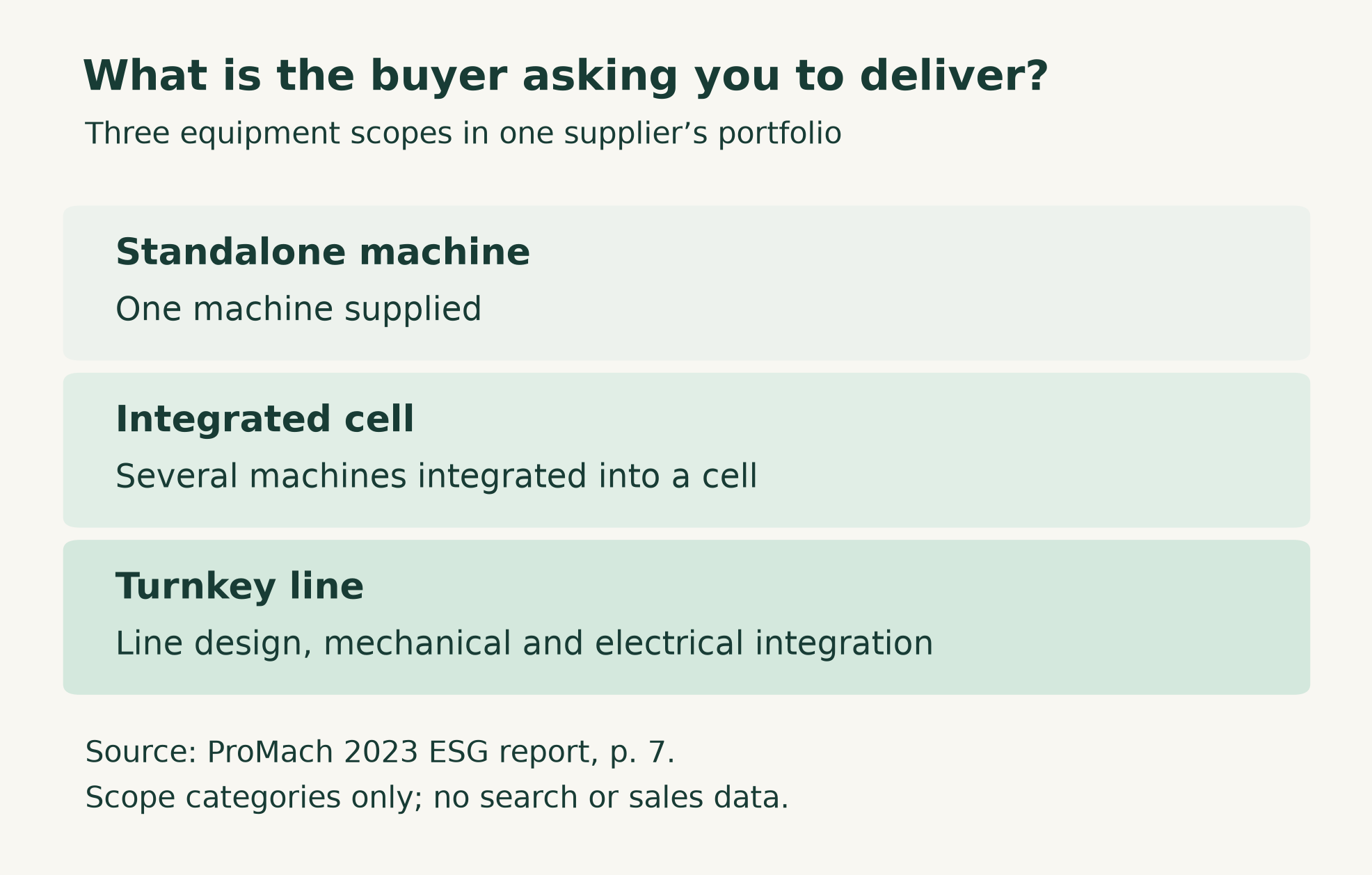
That distinction shows up outside the recording. PMMI's ProSource directory separates case or tray erectors and formers from equipment that combines erecting, loading, and sealing. ProMach describes three delivery scopes in its 2023 report: standalone machines, integrated cells, and complete turnkey lines. The directory categorizes equipment and the manufacturer describes its own offerings. Together they provide a useful check on the vocabulary. Neither tells you how a buyer searched, how much any term is worth, or how the whole industry organizes its services. [1] [2]
When you interview suppliers and your own application engineers, ask for the phrases people use when handing off a project. Who owns the mechanical interface? Is there an existing controls standard? Is the customer asking for a replacement, for several stations to work together, or for someone to guarantee a result across the line? Compare those phrases with real quote requests and distributor conversations in the target market. Save the wording, where it came from, and what the speaker meant. A supplier's label is a candidate until you see buyers use it or can connect it to a real purchasing task.
Read competitor ads through the business behind them
In a separate recording, Yiwei suggests looking at competitors that advertise over time. His useful distinction is between a company that needs a lead to convert on one product line and a company that can route the same lead across several lines. For instance, an integrator could hypothetically move an inquiry from a whole-line project to a smaller cell retrofit when the scope changes. A machine-only exporter might have to decline it. Each firm can reasonably assign a different value to the same inquiry.
Use competitor ads to collect language, offers, and landing-page ideas. Put a question mark next to the economics. Seeing ads over time doesn't reveal what the advertiser paid, what queries actually triggered the ads, what closed, or which business unit received the revenue. Even with a close competitor, an offer that works with local installation and field service may fail to transfer to an exporter who ships equipment and relies on the buyer's integrator. Before you borrow the offer, have sales explain who would take the call and what they could quote.
Turn the search term into a page decision
For each promising phrase, write a sentence: “A buyer in this situation wants us to deliver ___, and the team responsible for delivering it is ___.” If you can't finish the sentence, leave the term in research. If you can, use the expected deliverable to decide what goes on the site.
- For a standalone machine, give buyers the inputs they need to rule it in or out: case formats and dimensions, rated throughput with its test conditions, footprint, and the handoff to adjoining equipment. Ask for a case specification and target rate in the quote request.
- If the buyer already has an integrator, consider adding interface drawings, controls information, or a division of responsibilities to the equipment page. A dedicated integration guide makes sense when it answers a recurring technical question. Its call to action can be a compatibility review with the integrator, rather than a quote for the whole line.
- If your team delivers an integrated cell or a turnkey line, give that offer a dedicated page when you can explain its distinct scope. State which stations or interfaces are included, who owns commissioning and acceptance, and what support is available at the buyer's site. If a partner leads the work, name the division of responsibility and route the inquiry to the party that can answer it.
A separate page earns its place when the buyer needs different evidence and a different next step. Three phrasings for the same machine can usually share one page. A large search estimate for integration does little for an exporter that cannot answer who owns site acceptance. On the other hand, a technically precise phrase with sparse data can still justify a guide if sales repeatedly fields that question and can show the answer.
Measure what sales can do with the demand
Start with one market and one equipment family. Pick a known machine phrase and one adjacent phrase from an interview or quote request. In Search Console, select a visible query and check the Pages tab to see which URLs already appear for it. That can tell you whether to improve an existing page before commissioning a new one. Use a consistent country and date range. Google omits some queries and can truncate rows, so a missing term isn't proof that nobody searches for it. Search Console helps you diagnose visibility at the query and page level; it doesn't identify the query behind each sales opportunity. [3] [4]
For the first review, tag inquiries by landing page where you can observe it, requested scope, and sales outcome. A useful tally separates forms received, inquiries the team can serve, and opportunities that move to a quote. Keep reasons for rejection, such as unsupported installation territory or a request for full-line controls. Compare inquiries from the same intake period after enough time has elapsed for qualification. If you also run paid search, Google Ads allows you to record qualification and a later conversion step from offline data. Choose the stages your team actually applies, and keep ad attribution separate from what you can observe about organic traffic. [5]
If a page attracts more quote requests but most go to another team or get declined, look at the promise in the headline and form first. An integration phrase can still belong on a component page as context, or in a guide written for the partner who actually buys the machine. The test for the next page is simple: would someone from sales or engineering be happy to receive the inquiry it promises to generate?
Research and sources
- PMMI ProSource — Case packing equipment categories · Checked on 2026-11-04
- ProMach — 2023 ESG Report, p. 7 · Checked on 2026-11-04
- Google Search Console — Common tasks in the Performance report · Checked on 2026-11-04
- Google Search Console — Query omissions and data groupings · Checked on 2026-11-04
- Google Ads — Qualified leads and converted leads · Checked on 2026-11-04
Original source material used in this article: