Improve GEO Without Breaking the SEO You Already Have
A practical content workflow: develop original ideas, cluster fan-out questions, and check multilingual pages. Includes a sourced research chart and an actionable decision table.
Do not turn every fan-out query into a new page
One of the strangest GEO implementations I have seen starts with a fan-out query and ends with a separate page for every sub-question. The problem is that the next run may produce a different set of questions. Meanwhile, the site has already committed its structure, articles, and internal links to one model output. More pages do not necessarily give readers a more complete answer. They can fragment the explanation readers actually need.
Three parts of my content work connect here: developing a point of view before validating keywords, understanding what an existing page does before expanding it for GEO, and checking whether each language version can be understood on its own terms. Content production, page updates, and language configuration should support the same goal: turning real experience into material that people can find, read, and verify over time.
Google’s current guidance places optimization for generative search within the foundations of SEO. It describes query fan-out as related searches around a question; it does not require a separate page for every wording. My practical inference is to organize information around the reader’s task first, then decide where page boundaries belong. A model-generated list of questions is useful research input, rather than an automatic site map. [2]
Start with something worth saying, then validate demand
When I write an SEO blog, I often have a draft before I start working on keywords. I use a browser agent to read the video, distill the speaker’s ideas together with my own thinking, and develop an article. Then I add reliable references, validate the relevant keywords, and integrate them naturally. This is my own production sequence, rather than a universal prescription for every site. It addresses a familiar problem: a full keyword spreadsheet does not give a writer an original judgment.
A short spoken piece may contain a useful observation without enough explanation, exceptions, or practical steps to support a newsletter. In that situation, I would combine related material around one reader question. One source might provide the observation, another explain the mechanism, and a third establish the conditions for applying it. The combined article must add understanding. Joining short posts together, substituting synonyms, or stretching the introduction does not complete the editorial work.
Length serves a supporting role. A substantive newsletter needs room to develop its argument, but a length target is not a Google ranking requirement. The real test is whether each section earns its place through evidence, judgment, or a useful action. If a draft lacks the research needed to support its central claim, publishing less often is a better editorial decision than filling the gap with generic background.
Add evidence without turning a study score into a business result
The GEO paper offers a useful way to test our intuition. The chart below redraws selected results from the same column of Table 1 in the 2024 paper: no optimization scored 19.3, keyword stuffing 17.7, citing sources 24.6, adding statistics 25.2, and adding credible quotations 27.2. These are absolute experimental scores. They are not organic rankings or percentages of client traffic growth. [1]
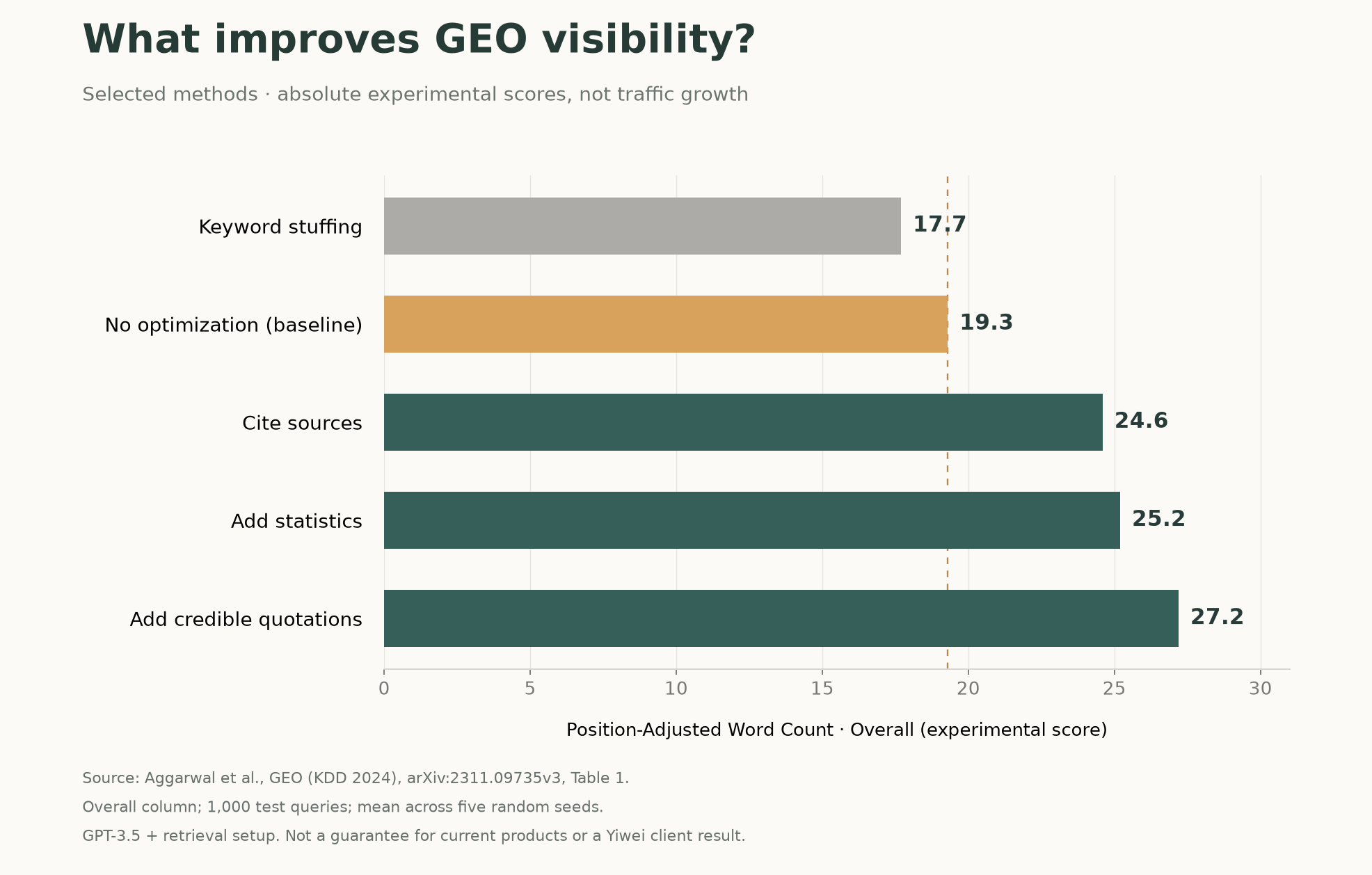
The paper reports a test split of 1,000 queries and averages across five random seeds. The experimental engine behind this table combines retrieval with GPT-3.5. That makes the findings a reason to investigate evidence and presentation, rather than a promise of identical results in every current AI product. My editorial inference is a hypothesis to test: making an argument easier to check deserves attention before increasing the density of terminology. [1]
A research chart should answer a question raised by the article. Readers should be able to trace the numbers to a source, year, and measurement definition. The caption should explain the scope, and the prose should explain how the evidence bears on the argument. When reliable quantitative data is unavailable, a sourced comparison or decision diagram may be more useful. Inventing a growth curve to make a piece look researched is not an acceptable substitute. References are entry points into the reasoning.
Put missing answers into the right page
Before changing a mature page that already receives SEO traffic, I look at Search Console: which queries currently generate impressions and clicks, and which parts of the page may support conversion? I then cluster the unanswered questions. Some belong to the same reader task; others may genuinely deserve a standalone page. The useful output is an explanation of why a change belongs where it does, rather than another list of keywords.
Definitions, evidence, and comparisons within the same topic can often fit into a relevant H2 section on an existing page. A substantially different task, a dedicated tool, or a different audience may justify a separate page. Added paragraphs still need to connect to the original argument. Appending a disconnected list of questions and answers does not solve that problem. Protecting existing SEO starts with understanding the job the page is already doing.
| What you find | First action | What to verify |
|---|---|---|
| Several sub-questions serve one task | Cluster them into the existing topic page | Logical transitions, complete evidence, and continued coverage of existing queries |
| A question needs its own tool or task | Assess a separate page and internal links | Whether the task stands alone and whether it overlaps with the existing page |
| Language pages all point to an English canonical | Check representative URLs and language relationships | HTML signals, Google-selected canonical, and consistency of language links |
After a change, I would record its date, affected URLs, added topics, and the prior query baseline, then observe the actual outcome. Impressions, clicks, inquiries, and AI citations measure different things. A page appearing in one generated answer does not establish business growth. Without a reliable comparison, the conclusion should remain an observation, rather than becoming an unsupported claim about how much the update improved performance.
Check the multilingual chain beyond translation
In a foreign-trade client example I discussed in a video, the site had multiple languages but its traffic was concentrated in English. When I checked the configuration, the Spanish, Portuguese, and Chinese pages all pointed their canonical tags at the English version. This is the client observation described in that source. It is not a fresh, independently reproduced site audit for this article, and it does not establish a post-fix traffic result.
A canonical is a signal of the preferred representative URL, rather than a command guaranteed to be followed. Google’s documentation recommends choosing a canonical in the same language when using hreflang, or the best possible substitute when that language is unavailable. For complete language versions intended to participate independently in search, I would therefore check whether self-canonicals make sense, then inspect reciprocal hreflang relationships and whether each version includes itself. Those signals answer different questions: which URL is representative, and which pages are language alternatives? [3] [4]
Once the configuration has been checked, the content still needs review. Does it use expressions that local readers expect? Are product conditions and use cases appropriate? Do forms and purchase paths work? I also noted in the original video that content generated with AI coding tools needs spot checks for lost accented characters in languages such as French and Italian. A file existing, a translation being complete, and a reader being able to use the page successfully are separate outcomes. A file count alone cannot verify all three.
A practical check before the next publication
- Define one real reader question. Write down the new judgment the article will offer and which verified source material supports it. If the material is insufficient, keep collecting.
- Separate personal observations, published research, and editorial inferences. Preserve the source of every important number, and do not present a study as a client result.
- Create at least one research visual that contributes to the argument. Keep the underlying data and measurement notes, and check whether its labels and sources remain readable on a phone.
- Review the complete article for information gain, then check references, canonicals, language configuration, internal links, and whether the chart actually loads.
- Keep a record of the publication and its distribution status. A failed channel should be resumed from its actual state; it is not a reason to duplicate an article or send the same email twice.
The growth articles worth keeping should let a reader arrive with a concrete question and leave with checkable reasoning and a useful next step. Spoken material contributes experience and a point of view. Research contributes evidence. Editing connects them into a complete argument. Once those three jobs are done, distribution and publishing frequency can support the work instead of substituting for it.
Research and sources
- Aggarwal et al. — GEO: Generative Engine Optimization (KDD 2024, v3, Table 1) · Checked on 2026-11-02
- Google Search Central — Optimizing your website for generative AI features on Google Search · Checked on 2026-11-02
- Google Search Central — How to specify a canonical URL · Checked on 2026-11-02
- Google Search Central — Tell Google about localized versions of your page · Checked on 2026-11-02
Original source material used in this article: